
01 · The assessment method
Market and suburb
Does this market suit the purchase you are trying to make?
A suburb can be well regarded and still be the wrong market for a particular brief. The first task is to understand what supports demand, what constrains supply and which type of property the local buyer pool is most likely to keep wanting.
What Ben examines
- Available stock, sales volumes and how long suitable homes tend to remain on the market
- Affordability, household composition and the depth of owner-occupier demand
- The mix of houses, apartments and new supply rather than a blended suburb median
- Transport, schools, employment and amenities that affect how people use the area
- Longer-term sales history, treated as context rather than a forecast
How to read it
A low level of stock can indicate scarcity, but it does not make every property scarce.
Recent growth can reflect the type of homes that happened to sell, particularly in a small market.
A suburb forecast is a third-party estimate. It cannot establish the value or future result of one property.
The level of analysis
The median is one number in a much larger decision.
Houses and units are assessed separately. The data narrows the field and identifies the questions worth investigating; it does not choose a suburb or property on its own.
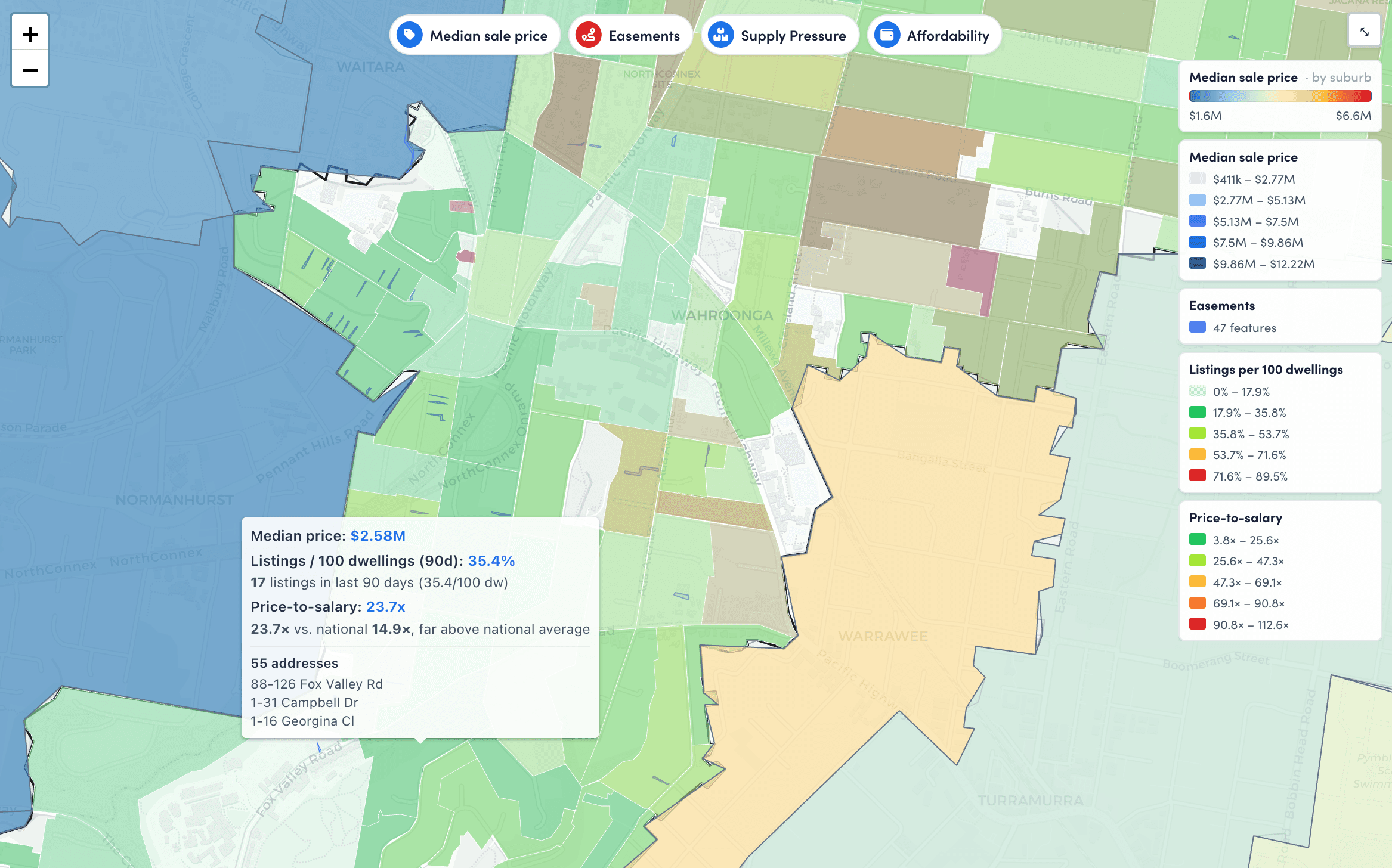
A suburb result is the beginning of the analysis.
This Wahroonga extract compares small-area price, supply and affordability signals. The figures narrow the search and identify what needs investigation; they do not select a property or predict its future value.
Price and market direction
Median sale and rent, one-, three-, five- and ten-year history, sales volume, price bands and third-party model ranges.
Supply and demand
Stock on market, months of inventory, new listings, days on market, auction clearance, vendor discounting, vacancy and hold periods.
People and liveability
Owner-occupier and renter mix, household composition, income, schools, transport, amenities, safety and the local buyer pool.
Risk and future change
Zoning, development applications, building approvals, housing mix and address-level environmental or planning constraints.
Pocket and street evidence
Small groups of nearby homes, recent like-for-like sales and the local differences a suburb-wide result can conceal.
Ben’s interpretation
Which signals agree, which conflict, what remains uncertain and what the combined evidence changes about the search.
Forecasts and composite scores are third-party estimates, not Ben Drayton forecasts. They are considered alongside the underlying data and their stated confidence, never as a guaranteed outcome.
Suburb report
Request the report for a suburb you are considering.
Tell Ben the suburb and the type of property you are weighing. He will confirm whether a current report is available and explain which parts of the data matter for your brief.
A suburb report is a starting point. It does not replace address-level due diligence or a live read of the campaign.
Choose a time that suits you. Calendly will confirm the call and add it to your calendar.
Discuss this suburb with BenChoose a suitable time directly in Calendly.
What this changes
The market analysis should narrow the field. It tells Ben which suburbs deserve closer work and which property types fit the brief. It does not replace the pocket, property or campaign assessment that follows.
The limit
Suburb data is aggregated and time-sensitive. Conditions can differ by property type, price band and campaign, and the figures need to be refreshed before they are used in a live decision.
Continue through the method
Apply the method to a real property.
Bring the brief, shortlist or campaign you are weighing. Ben will explain which evidence matters, what remains uncertain and what the next decision requires.