
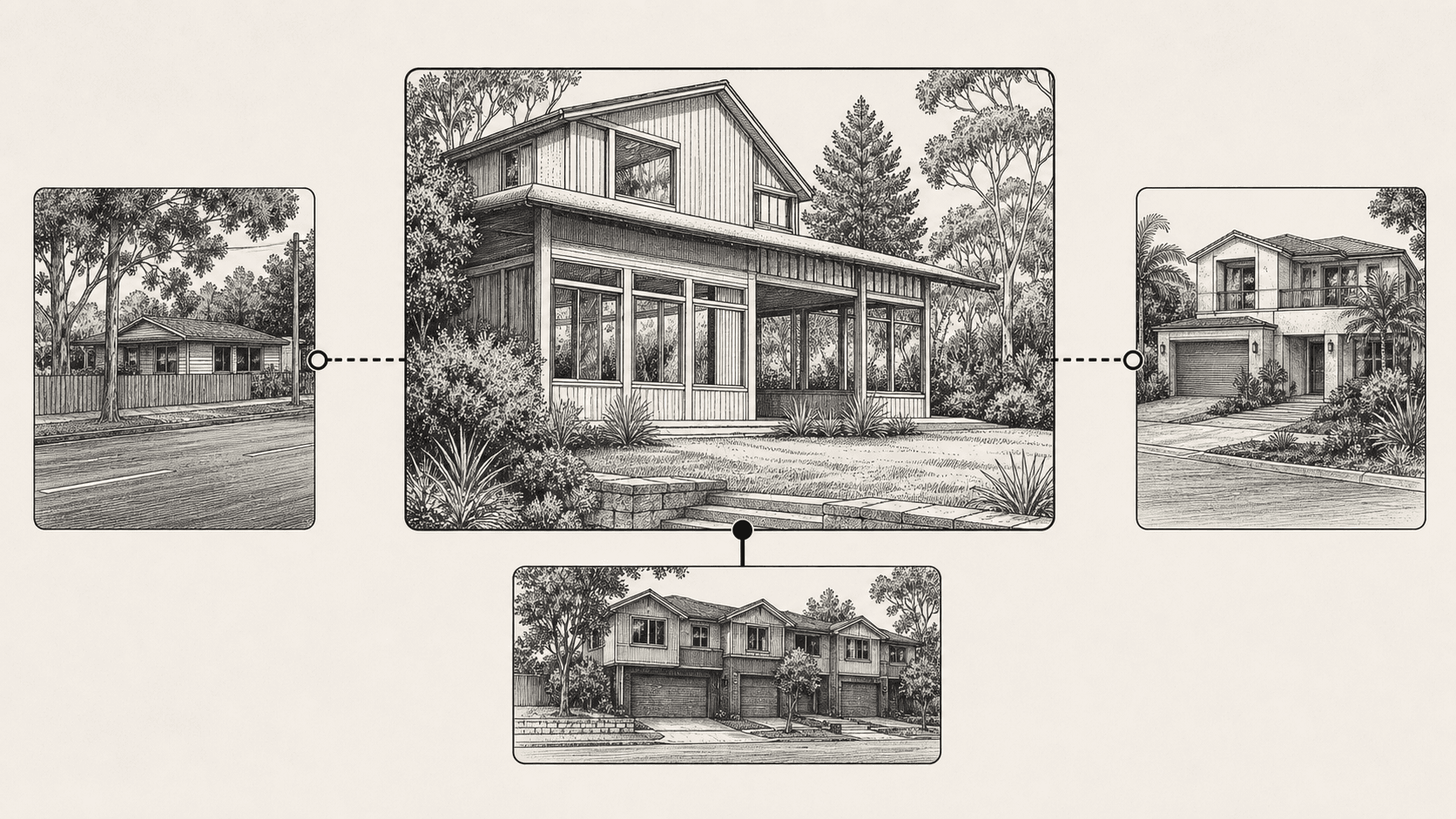
A recent sale in the same suburb is a nearby sale. It becomes comparable only when the important differences can be understood and adjusted.
Match the buyer pool
Start with the people who would have considered both properties.
A downsizer apartment, family house, development site and heritage semi can sit in the same postcode while competing in different markets.
Compare the position
Check:
- pocket and street
- traffic, rail and aircraft noise
- school and station route
- outlook, privacy and orientation
- flood, bushfire or planning context
- nearby development
A better-known street can still be inferior for a particular household if the property sits on the wrong corner.
Compare the land and dwelling
For houses, assess usable land, slope, access, aspect, building condition and layout.
For apartments, assess the building, floor, view, natural light, parking, storage, strata condition and amount of competing stock.
Bedrooms and bathrooms are the start of the comparison, not the conclusion.
Adjust for time and campaign
Market conditions can change between sales. The method of sale and buyer depth also help explain why a result occurred.
An unusual result should not become the anchor merely because it is recent. Read how it was achieved and whether another buyer would treat it as relevant to the target.
Build a range, not a single answer
Use inferior evidence to support the lower end and superior evidence to cap the upper end. Make each adjustment visible.
The aim is not false precision. It is a defensible range that shows what would have to be true for the target to sit above or below it.
Then read the campaign separately. The price guide, vendor preference and number of serious buyers affect the offer strategy, not the independent evidence.
See how Ben reads campaign and price and when to walk away.
Method and limits
This is Ben's professional comparison method, not a formal valuation standard. The available sales, appropriate time period and weight given to each adjustment depend on the property and market segment. A licensed valuer should be engaged where a formal valuation is required.