
Most of the property headlines at the moment are about prices falling, forecasts being cut and buyers finally getting some leverage.
If you are sitting on the sidelines waiting to see whether prices fall further, I understand the logic. In some parts of the market, they may.
But the quieter fact is that Australia still does not build enough homes in the places people want to live. That problem has not disappeared because prices have softened for a few months.
This does not mean prices cannot keep falling. It means a buyer should be careful about building a long-term decision around the assumption that they will.
And when governments announce large housing pipelines, there is another distinction worth making: an approval is not yet a home.
The headline and the buyer’s question
NSW total dwelling approvals rose 13.2% in June 2026 to 5,063, according to the ABS. Private-sector house approvals moved the other way, falling 0.3% to 2,280.
Both figures are correct. They answer different questions.
The total tells us that more dwellings received approval during the month. It does not tell a North Shore buyer that more established family houses became available, or that the approved mix resembles the homes on their brief.
The buyer’s question is narrower: how much completed stock will arrive, when will it arrive, where will it be, and will it be a genuine alternative?
Five stages that should not be collapsed into one number
Housing supply moves through a chain:
- Declared: a proposal enters a priority or assessment pathway.
- Lodged: an application has been submitted.
- Approved: permission has been granted.
- Commenced: construction has begun.
- Completed: a dwelling exists and can become usable supply.
The stages are related, but they are not interchangeable.
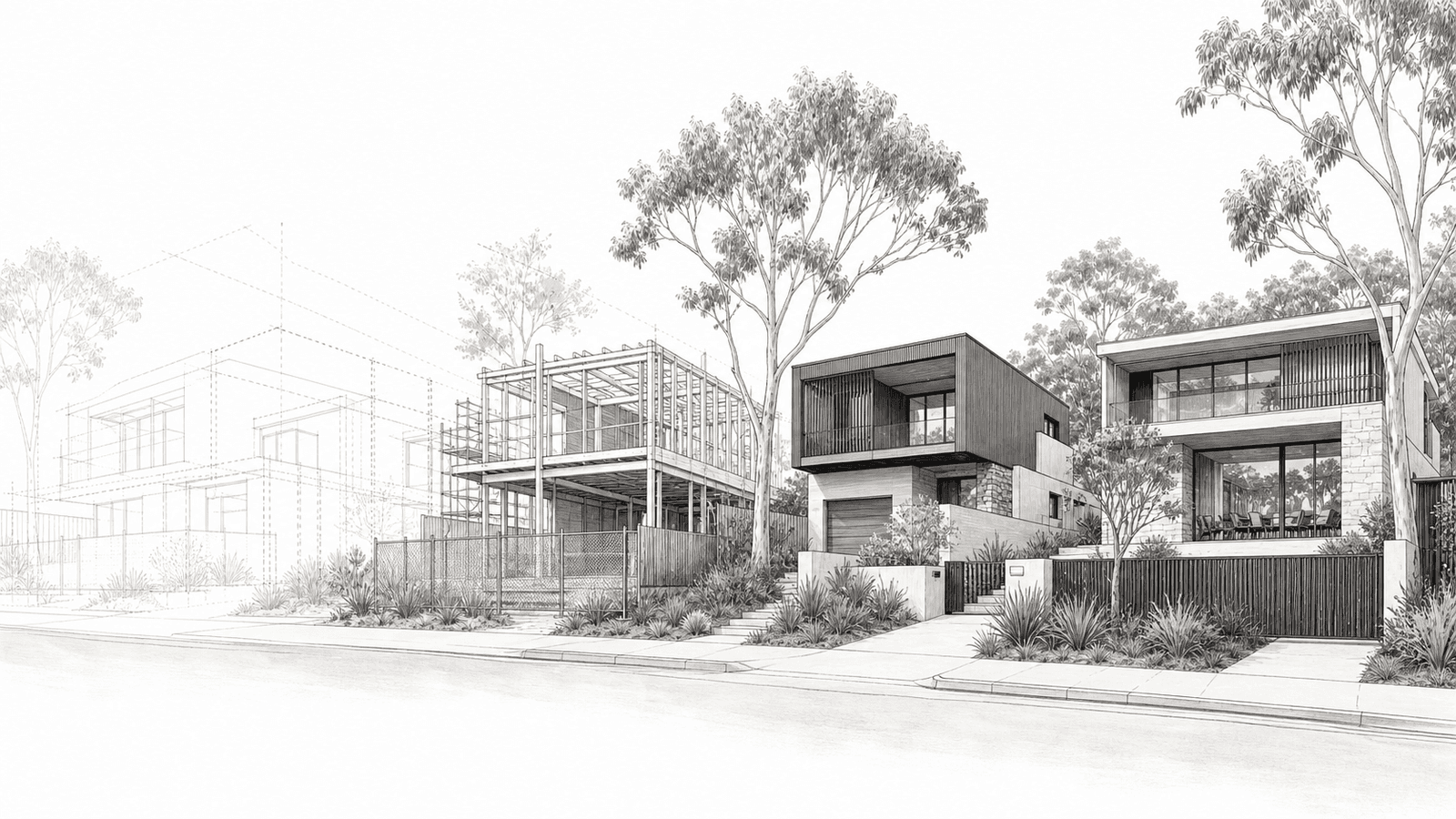
An approval is meaningful. It removes one barrier and gives us information about the future pipeline. It still sits before financing, presales, construction capacity, site conditions, delivery time and completion.
That is why “homes approved” should not be read as “homes available”.
The NSW pipeline is substantial
By 31 July 2026, the NSW Housing Delivery Authority had declared 493 proposals representing close to 153,000 potential homes. Eighty-one lodged applications represented around 26,600 potential homes, while 14 approved projects represented more than 2,500. The update did not report how many had commenced.
This is evidence of substantial planning activity. It may improve supply over time.
It is not evidence that 153,000 homes are about to reach the market. “Potential”, “declared” and “approved” describe different points in the process.
The first HDA-approved project was in Gordon. That makes the program locally relevant to Upper North Shore buyers. The public release did not establish when those homes would be completed, and an apartment project in Gordon is not automatically comparable with an established house sought by a family elsewhere on the North Shore.
Geography is not enough. Dwelling type, land, layout, condition, school access, transport, amenity and price all determine whether new stock is a real substitute.
Falling prices and a housing shortage can exist at the same time
Official national housing analysis continues to show a supply shortfall relative to Australia’s needs and the National Housing Accord target.
The target requires 240,000 completed homes a year. The ABS recorded approximately 173,000 seasonally adjusted completions over the latest four reported quarters to March 2026, roughly 28% below that annual pace.
At the same time, prices have recently been falling in parts of Australia. Listings, borrowing costs and buyer confidence affect what happens now. The supply shortage affects the longer-term balance between the number of homes and the number of households that want them.
There is also a feedback effect. In its August 2026 Statement on Monetary Policy, the RBA reported lower new-home sales and softer developer sales momentum. If expected selling prices fall while construction costs remain high, some proposed developments become harder to justify. That does not mean falling prices prevent all new supply. It means a planning approval still has to pass a commercial and construction test before becoming a completed home.
Both can be true.
It does not follow that every property is scarce, every approved project will be delivered, or every buyer should bring a purchase forward.
A national shortage is context. It is not a timing signal, and a buying decision is still local and specific.
My read is that prices can fall further from here. I would be much less confident assuming they can keep falling broadly for a long period while the underlying shortage remains unresolved.
That view would change if demand weakened for longer than expected, unemployment or forced selling rose materially, credit tightened further, or completions began to close the supply gap faster than current evidence suggests.
The strongest alternative view is that approvals are a leading indicator: more approvals today can mean more completions later, and faster planning may improve the conversion rate. I agree. The mistake is not taking approvals seriously. The mistake is treating them as completed, comparable choice before that conversion occurs.
Searching properly is different from waiting for the bottom
If you intend to buy, I would not describe the better approach as waiting for the right property. It is an active search.
The brief has to be made clear. Finance has to be ready. Suburbs and individual streets need to be understood. Agents need to know what you are looking for. Properties need to be screened, inspected, valued and investigated. Most of the work happens before the successful offer.
That takes time. REA Group’s 2025 Property Seeker Survey put the broader Australian journey from monitoring the market through paperwork and settlement at about 40 weeks. That is not a forecast for an individual buyer, but it is a useful reminder that buying is rarely one Saturday inspection followed by an exchange.
While that work is happening, the market may turn anyway.
I would be cautious about sitting outside the search and waiting for the market to ring a bell at the bottom. It never does. You only know the low point after it has passed. In the meantime, a genuinely good property can sell and may not be replaced by another one with the same location, land, layout and liveability.
Sydney’s median house price was about $1.73 million in June 2026. That figure does not tell us what the next year will produce, and an individual property can do much better or worse than a median.
Take a simpler illustration. If a $1.5 million property grew at 6% a year for ten years, it would be worth about $2.69 million. The nominal increase would be about $1.19 million, before buying and selling costs, finance, tax, maintenance and improvements.
A buyer who timed a further 5% fall perfectly would save $75,000 on the purchase price. That is meaningful. But it is much smaller than the illustrative ten-year movement, and the calculation assumes the same quality property is still available at the lower price.
That is the part market-timing discussions often miss. Property is not an index. Two houses in the same suburb can produce very different outcomes, and the stronger one may not still be available when the index turns.
I would rather buy an A-grade asset at a fair price than a compromised property at the perfect point in the cycle. For me, that means the Four Ls: location, land, layout and liveability. If those fundamentals are right, the buyer has something worth holding while the market moves through shorter cycles.
The limit is important. Six per cent is an illustration, not an expected return. Growth is uneven, holding costs matter and there can be long periods with little or no price growth. The point is not that buying now must work. It is that running the search properly, selecting the asset and paying a defensible price are decisions a buyer can control. Calling the exact bottom is not.
A practical test before deciding to wait
If future supply is part of your decision, build a short comparison table.
For each proposed or approved development, record:
- its current stage;
- the expected completion date, if one is publicly supported;
- the dwelling type and likely configuration;
- the location and compromises;
- the likely price range, clearly marked as unknown where evidence is absent; and
- whether you would genuinely choose it over the established home in front of you.
If the final answer is no, it is not comparable supply for your decision.
My read is to treat the pipeline as possible future supply, not current choice.
There may be good reasons to pause: finance is not ready, the brief is unresolved or the available properties are poor. “Prices are falling, so they must keep falling” is not enough on its own.
If you intend to buy, keep doing the work that makes a sound purchase possible. Do not sit outside the search because a national headline or a large approvals number appears to promise a cheaper home later.
Approved projects may be built, and reforms may improve delivery. The current figures do not prove a permanent shortage or tell us what prices will do next.
They do show why an approval is not yet a home.
If you intend to buy, keep the search moving: clarify the brief, prepare finance and assess each opportunity against the Four Ls. Pomona can help you run that process.