
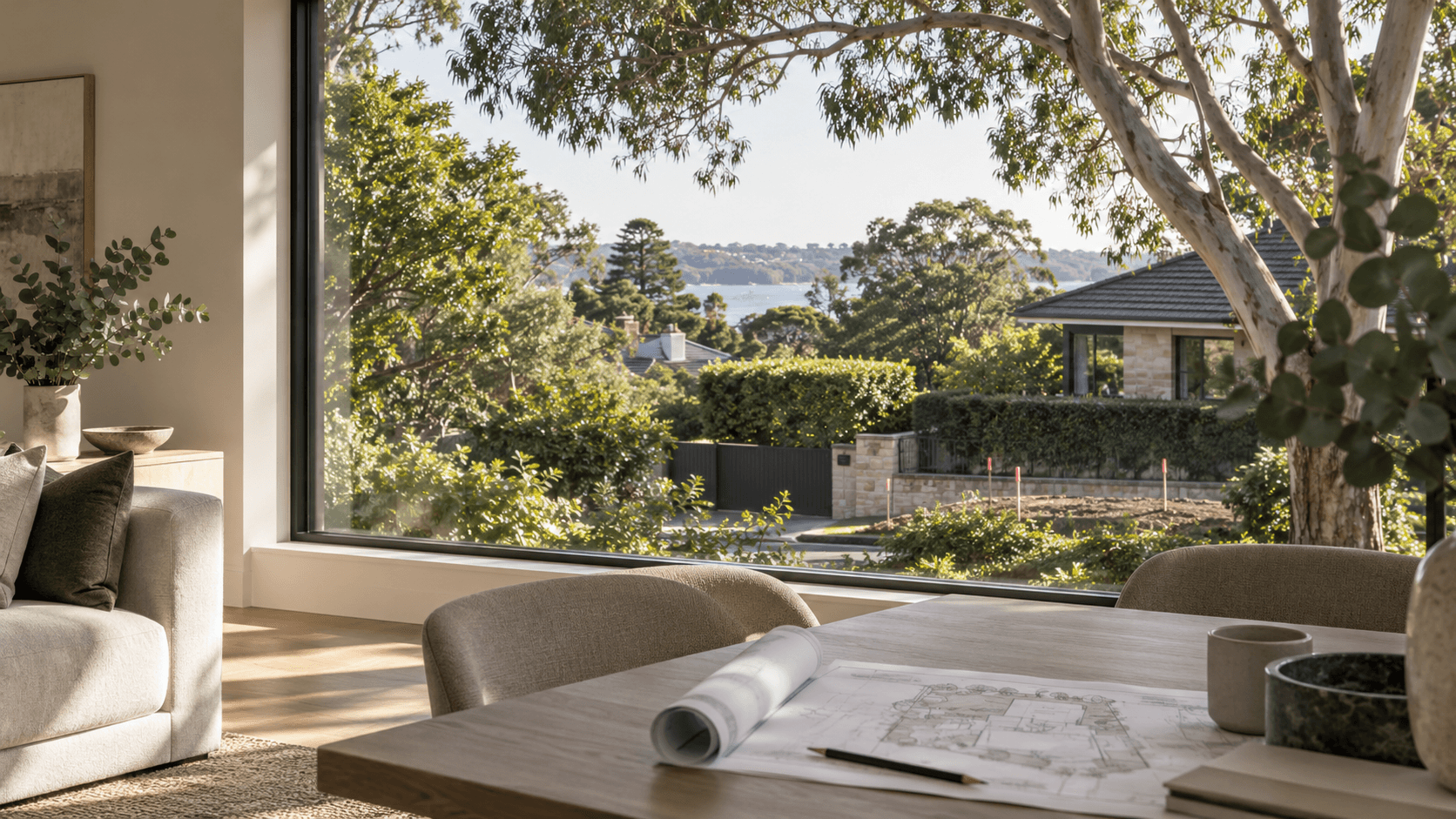
The outlook can become part of the price before a buyer has worked out whether it is likely to last.
At an inspection, the adjoining block may look settled. There is no development sign, no obvious demolition work and no council letter in the buyer's hand. None of those observations proves that the setting will remain unchanged.
That distinction matters more in NSW from 1 September 2026. Under the statewide Community Participation Plan, some lower-impact development applications that comply with height and floor-space-ratio controls no longer require public exhibition. They still require assessment, and amenity impacts still need to be considered. But the absence of a notification letter is no longer a complete warning system.
The useful question is not, “Can somebody build next door?” In most established suburbs, some form of change is possible. The useful question is: what could change, how likely is it, and what would that mean for this particular home?
Start with the amenity you are buying
Name the feature before searching for threats to it.
- morning light into the kitchen
- northern light into the living area
- privacy from bedrooms or the rear garden
- district, water or leafy outlook
- a quiet edge created by the neighbouring use
- mature trees that screen another property
This keeps the review connected to the buying decision. A two-storey proposal may be immaterial to one home and decisive for another because of their orientation, levels and window positions.
It also prevents a common mistake: treating “no development application found” as the conclusion. The buyer is assessing the durability of an amenity, not completing a database search for its own sake.
Inspect the sites capable of changing it
Begin with the adjoining properties, the site opposite and any land within the important view or sunlight corridor. Then look for characteristics that make change more plausible:
- an underdeveloped block relative to its neighbours
- a corner or unusually large site
- several adjoining lots that could be consolidated
- an older dwelling in a location experiencing redevelopment
- a non-residential use that may not be permanent
- recent survey, demolition or construction activity
These are prompts to investigate, not proof of an intended project. A large block can remain unchanged for years. A modest-looking site can already have an application or approval.
Search the application record, not only public exhibitions
Use the NSW Planning Portal Application Tracker to search the subject property and nearby addresses. The tracker can be filtered by address, date, development type and application status. If an application is not there, check the relevant council's own tracker as well.
Search for more than current applications. Look for:
- applications that have been submitted but not determined
- approved applications that may not yet have started
- refused or withdrawn schemes that show development intent
- modification applications that change an earlier approval
- complying development or other records shown by the relevant system
Do not rely only on a council's “on exhibition” page. An application can exist without being open for public submissions. Hornsby Council, for example, explains that many application types stopped being publicly notified under the statewide plan, while applications can still be viewed and tracked.
Read the proposal, not just its description
“Alterations and additions” can describe a small internal change or a substantial upper-level addition. “New dwelling” does not tell you where the building sits, how high its finished levels are or which windows face the property you are considering.
Where documents are available, inspect:
- the site plan and setbacks
- floor plans and elevations
- building and roof heights
- shadow diagrams
- overlooking and privacy treatments
- tree-removal and landscape plans
- excavation, retaining walls and access
- the statement of environmental effects
- the determination and approved plans, if already decided
Read the status and dates carefully. A lodged proposal is not an approval. An approval is not proof that construction is imminent. A refused scheme may still be redesigned and lodged again.
Check the planning controls as well as live applications
A clean application search only tells you that you did not find a recorded proposal in the systems checked. It does not tell you what the neighbouring land may support later.
Review the relevant zoning, maximum building height, floor-space ratio, minimum lot size, heritage controls and any site-specific provisions. For a material concern, ask a town planner to interpret the controls against the actual site.
Planning controls set a framework, not a prediction. Site constraints, design, assessment, owner intent and future rule changes all affect what may happen. The honest output is therefore a risk judgement with stated limits, not a guarantee that the outlook is protected.
Turn the finding into a buying decision
For each material issue, write down four things:
- Effect: What would change for the home: sunlight, privacy, outlook, noise, access or resale appeal?
- Likelihood: Is there a live application, an approval, visible preparation, development capacity only, or no evidence beyond a theoretical possibility?
- Timing: Is the change active, approved but uncertain, or only a longer-term scenario?
- Confidence: Which records were checked, on what date, and what could not be verified?
That may lead the buyer to proceed unchanged, seek specialist advice, adjust the price, negotiate a protective term where appropriate, or reject the property. The right response depends on how important the amenity is to this buyer and whether the risk is already reflected in the price.
The key is to avoid paying as though a borrowed outlook, borrowed privacy or borrowed light is permanent when the evidence does not support that assumption.
A practical pre-offer check
Before treating the setting as part of the home's value:
- identify the exact light, privacy or outlook being relied on
- inspect the adjoining, opposite and view-corridor sites
- search both the NSW tracker and the council tracker
- check submitted, determined and modified applications
- read plans and supporting documents where available
- review the current planning controls
- record what was checked and when
- escalate material uncertainty to the appropriate planner, solicitor or other adviser
This sits inside a wider property due-diligence process. It should also be read alongside why the street can matter more than the suburb.
Sources and limits
- NSW Planning: Community Participation Plans, accessed 8 October 2026. Statewide notification and exhibition settings effective from 1 September 2026.
- NSW Planning Portal: Application Tracker, accessed 8 October 2026. Address, date, development-type and status searches.
- Hornsby Shire Council: Find and track a development application, accessed 8 October 2026. Local tracking and the effect of the statewide plan on notification.
Planning records and controls change. Search results can be incomplete or held across different systems. This article is general information, not planning or legal advice. Obtain property-specific advice where development risk is material to the purchase.